




Seeing is Believing: The Incredible Impact of X-Ray Technology

Mohamad-Ali Salloum, PharmD • September 17, 2024

Share

  • Slide title

    Write your caption here
    Button
  • Slide title

    Write your caption here
    Button
  • Slide title

    Write your caption here
    Button
  • Slide title

    Write your caption here
    Button

These strong rays have been used by doctors and scientists for almost a century to gaze into the mysteries of the human body and beyond. But did you know that X-rays were found entirely by chance


In 1895, Wilhelm Conrad Roentgen, a German physicist, was experimenting with cathode rays (aka electric currents) when he noticed an unusual glow coming from a nearby screen. He had no idea that this unintentional discovery would forever revolutionize the world of medicine! 

Radiation such as X-rays can travel through the body. They are invisible to the naked eye and cannot be felt. 


The energy from X-rays is absorbed in varying rates by different regions of the body as they move through the body. After the X-rays have passed through, a detector on the other side of the body collects them and converts them into an image. 


Dense portions of your body, such as bone, that X-rays find difficult to get through, appear as distinct white patches in the image. Softer tissues that X-rays can easily pass through, such as your heart and lungs, seem darker.


So, what’s the true purpose of X-rays? 


They are commonly used for a variety of evaluations, of which we shall highlight a few:  


  • Dental X-rays are used in dentistry to obtain images of the teeth and surrounding tissues, which aid in the diagnosis of oral health concerns and treatment planning. 
  • Cancer Treatment: a type of radiation therapy that uses high doses of radiation to eliminate cancer cells in specific parts of the body. 
  • Veterinary Care: utilized in veterinary medicine to diagnose and treat animals, assisting veterinarians in the detection of fractures, cancers, and other health problems. 
  • Industrial inspection is used to inspect machinery and infrastructure in the industrial sector, assisting in the detection of flaws and the prevention of accidents. 
  • Forensic Science: a branch of forensic science that examines the evidence and reconstructs crime scenes to assist in identifying victims of crimes and accidents. 
  • Bone Density Testing: used to assess bone density and aid in the diagnosis of osteoporosis and other bone-related diseases. 


The chart below provides additional information about the medical applications of X-rays:
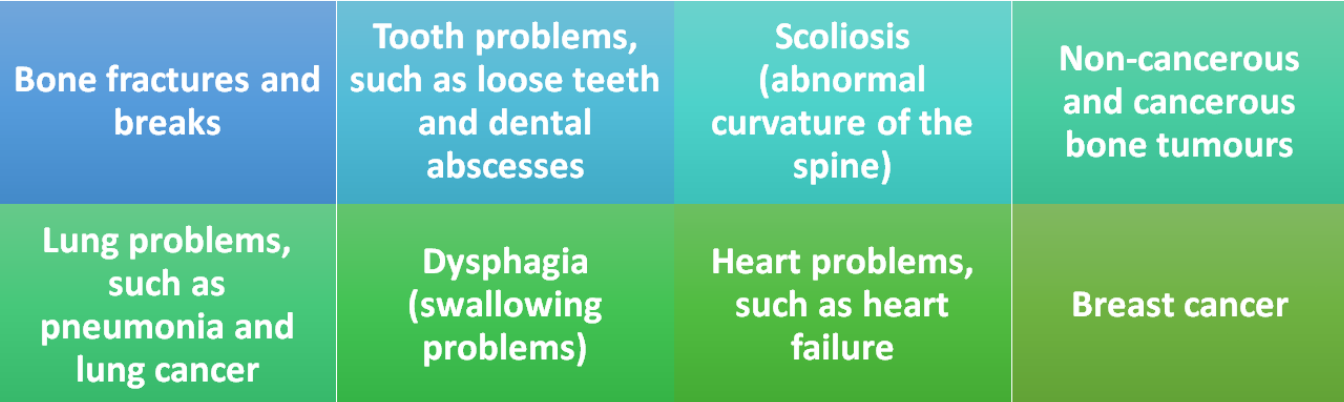

Medical Applications of X-Rays

Finally, while X-rays are a useful tool for medical diagnostics, they can have negative side effects when used incorrectly or at high dosages. Patients should consider the risks and advantages of X-rays with their healthcare providers and only have imaging tests performed if they are medically necessary. Medical staff should also take precautions to limit their patients' exposure to radiation. X-rays, when used correctly and with safeguards, can provide vital diagnostic information without causing major harm. 


Here are some of the side effects of X-rays that could be avoided: 


  1. Skin Damage: Exposure to high doses of radiation can cause skin redness, itching, and even skin burns. 
  2. Nausea and Vomiting: Some patients may experience nausea and vomiting due to exposure to high doses of radiation. 
  3. Cancer Risk: Long-term exposure to radiation can increase the risk of developing certain types of cancer, such as leukemia and thyroid cancer. 
  4. Genetic Mutations: Radiation exposure can cause genetic mutations that may be passed down to future generations. 
  5. Infertility: High doses of radiation can damage the reproductive organs, leading to infertility or other reproductive problems. 


List of Services

    • Slide title

      Write your caption here
      Button
    • Slide title

      Write your caption here
      Button
    • Slide title

      Write your caption here
      Button
    • Slide title

      Write your caption here
      Button

    ABOUT THE AUTHOR

    Mohamad-Ali Salloum, PharmD

    Mohamad Ali Salloum LinkedIn Profile

    Mohamad-Ali Salloum is a Pharmacist and science writer. He loves simplifying science to the general public and healthcare students through words and illustrations. When he's not working, you can usually find him in the gym, reading a book, or learning a new skill.

    Share

    Recent articles:

    By Mohamad-Ali Salloum, PharmD January 30, 2026
    References: Gooley JJ, Chamberlain K, Smith KA, et al. Exposure to room light before bedtime suppresses melatonin onset and shortens melatonin duration in humans. J Clin Endocrinol Metab. 2011;96(3):E463‑E472. [academic.oup.com] Chang AM, Aeschbach D, Duffy JF, Czeisler CA. Evening use of light‑emitting eReaders negatively affects sleep, circadian timing, and next‑morning alertness. Proc Natl Acad Sci USA. 2015;112(4):1232‑1237. [hms.harvard.edu] Schöllhorn I, Stefani O, Lucas RJ, et al. Melanopic irradiance defines the impact of evening display light on sleep latency, melatonin and alertness. Commun Biol. 2023;6:1090. [nature.com] He J‑W, Tu Z‑H, Xiao L, Su T, Tang Y‑X. Effect of restricting bedtime mobile phone use on sleep, arousal, mood, and working memory: A randomized pilot trial. PLoS One. 2020;15(2):e0228756. [journals.plos.org] Hartstein LE, Mathew GM, Reichenberger DA, et al. The impact of screen use on sleep health across the lifespan: a National Sleep Foundation consensus statement. Sleep Health. 2024;10(4):373‑384. [sleephealt…ournal.org] Höhn C, Hahn MA, Gruber G, et al. Effects of evening smartphone use on sleep and declarative memory consolidation in male adolescents and young adults. Brain Commun. 2024;6(3):fcae173. Finucane E, O’Brien A, Treweek S, et al. Does reading a book in bed make a difference to sleep? The People’s Trial—an online, pragmatic randomized trial. Trials. 2021;22:873. [link.springer.com] Ong JC, Manber R, Segal Z, Xia Y, Shapiro S, Wyatt JK. A randomized controlled trial of mindfulness meditation for chronic insomnia. Sleep. 2014;37(9):1553‑1563. [academic.oup.com] , [mindfulchair.com] He X, Pan B, Ma N, et al. The association of screen time and the risk of sleep outcomes: a systematic review and meta‑analysis. Front Psychiatry. 2025;16:1640263. Shechter A, Quispe KA, Mizhquiri Barbecho JS, et al. Interventions to reduce short‑wavelength light at night and their effects on sleep: systematic review and meta‑analysis. SLEEP Advances. 2020;1(1):zpaa002. [academic.oup.com]
    By Mohamad-Ali Salloum, PharmD January 29, 2026
    References: Harkin B, Webb TL, Chang BPI, Prestwich A, Conner M, Kellar I, et al. Does monitoring goal progress promote goal attainment? A meta-analysis of the experimental evidence. Psychol Bull . 2016;142(2):198–229. Available from: https://www.apa.org/pubs/journals/releases/bul-bul0000025.pdf Compernolle S, DeSmet A, Poppe L, Crombez G, De Bourdeaudhuij I, Cardon G, et al. Effectiveness of interventions using self-monitoring to reduce sedentary behavior in adults: a systematic review and meta-analysis. Int J Behav Nutr Phys Act . 2019;16(1):63. Available from: https://link.springer.com/article/10.1186/s12966-019-0824-3 Patel ML, Brooks TL, Bennett GG. Consistent self‑monitoring in a commercial app‑based intervention for weight loss: results from a randomized trial. J Behav Med . 2020;43:391–401. Available from: https://link.springer.com/article/10.1007/s10865-019-00091-8 Patel ML, Hopkins CM, Brooks TL, Bennett GG. Comparing self-monitoring strategies for weight loss in a smartphone app: randomized controlled trial. JMIR Mhealth Uhealth . 2019;7(2):e12209. Available from: https://mhealth.jmir.org/2019/2/e12209/ Lally P, Van Jaarsveld CHM, Potts HWW, Wardle J. How are habits formed: Modelling habit formation in the real world. Eur J Soc Psychol . 2010;40(6):998–1009. Available from: https://repositorio.ispa.pt/bitstream/10400.12/3364/1/IJSP_998-1009.pdf Singh B, Murphy A, Maher C, Smith AE. Time to form a habit: A systematic review and meta-analysis of health behaviour habit formation and its determinants. Healthcare (Basel) . 2024;12(23):2488. Available from: https://www.mdpi.com/2227-9032/12/23/2488 Gollwitzer PM, Sheeran P. Implementation intentions and goal achievement: A meta‑analysis of effects and processes. In: Advances in Experimental Social Psychology . 2006;38:69–119. Available from: https://www.researchgate.net/publication/37367696 Adriaanse MA, Gollwitzer PM, De Ridder DTD, De Wit JBF, Kroese FM. Breaking habits with implementation intentions: A test of underlying processes. Pers Soc Psychol Bull . 2011;37(4):502–13. Available from: https://dspace.library.uu.nl/bitstream/handle/1874/380229/0146167211399102.pdf Palmer CA, Bower JL, Cho KW, Clementi MA, Lau S, Oosterhoff B, et al. Sleep loss and emotion: A systematic review and meta-analysis of over 50 years of experimental research. Psychol Bull . 2023;149(11):2314–48. Available from: https://www.apa.org/pubs/journals/releases/bul-bul0000410.pdf Kong Y, Yu B, Guan G, Wang Y, He H. Effects of sleep deprivation on sports performance and perceived exertion in athletes and non-athletes: a systematic review and meta-analysis. Front Physiol . 2025;16:1544286. Available from: https://www.frontiersin.org/journals/physiology/articles/10.3389/fphys.2025.1544286/full Tadros M, Newby JM, Li S, Werner‑Seidler A. Psychological treatments to improve sleep quality in university students: systematic review and meta-analysis. PLoS One . 2025;20(2):e0317125. Available from: https://journals.plos.org/plosone/article?id=10.1371/journal.pone.0317125 Locke EA, Latham GP. Building a practically useful theory of goal setting and task motivation: A 35‑year odyssey. Am Psychol . 2002;57(9):705–17. Available from: https://med.stanford.edu/content/dam/sm/s-spire/documents/PD.locke-and-latham-retrospective_Paper.pdf
    By Mohamad-Ali Salloum, PharmD January 16, 2026
    Reference: ACRP. “ICH E6(R2) to ICH E6(R3) Comparison.” (Jan 28, 2025) — terminology & essential records: PDF Clinical Trials Toolkit. “Summary of Key Changes in ICH E6(R3).” (Mar 25, 2025) — proportionality, QbD, safety reporting: Article PharmaEduCenter. “Key changes between ICH GCP E6 R3 and E6 R2.” (Aug 10, 2025) — structure & glossary: Blog CITI Program. “Navigating the Transition from ICH E6(R2) to ICH E6(R3).” (Mar 12, 2025) — consent & site practices: Blog IntuitionLabs. “ICH E6 (R3) Explained.” (Updated Jan 13, 2026) — rationale, data governance: Deep dive
    By Mohamad-Ali Salloum, PharmD January 16, 2026
    By Mohamad-Ali Salloum, PharmD December 6, 2025
    Simplify your day with essentialism: set priorities, eliminate the non‑essential, time‑block deep work, and measure progress for stress‑free productivity.
    By Mohamad-Ali Salloum, PharmD December 6, 2025
    A runner’s guide to VO₂ max: why plateaus happen and how to fix them with long intervals, tempo, hills, cross‑training and smart periodization.
    By Mohamad-Ali Salloum, PharmD December 3, 2025
    Explore the science of cognitive dissonance and learn how attitude change occurs, why dissonance matters, and what recent brain studies reveal about decision-making and self-control.
    By Mohamad-Ali Salloum, PharmD December 3, 2025
    Discover the science behind willpower and impulse control. Explore Dr. David Lewis’s “zombie brain” model, the ego depletion controversy, glucose myths, and evidence-based strategies like the 3-second pause, mindfulness, and environmental design to build lasting self-control.
    By Mohamad-Ali Salloum, PharmD November 16, 2025
    Explore evidence-based insights into ACE inhibitors, calcium channel blockers, and ARBs for hypertension management.
    By Mohamad-Ali Salloum, PharmD November 15, 2025
    Discover the latest scientific evidence (2022–2025) on Branched-Chain Amino Acids (BCAAs)—their role in muscle recovery, performance enhancement, and safety.
    More Posts