





Where does the tattoo ink go?

December 28, 2021

Share

  • Slide title

    Write your caption here
    Button
  • Slide title

    Write your caption here
    Button
  • Slide title

    Write your caption here
    Button
  • Slide title

    Write your caption here
    Button

First, let's see the components of the skin:


- The first layer is called "Epidermis".

- The second layer is called "Dermis".

- The third layer is called the "Hypodermis", where the fat layer is found
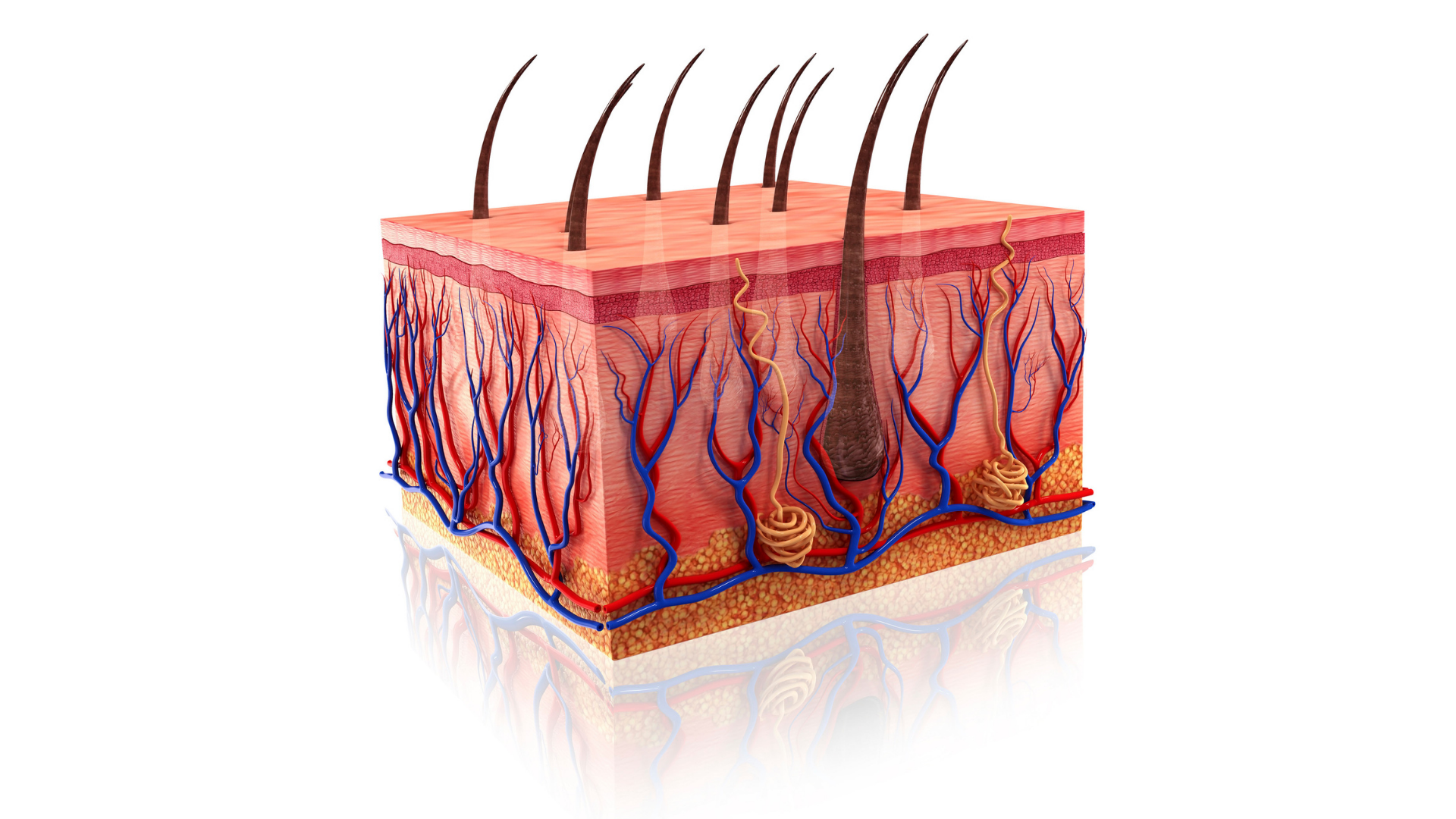
When doing a tattoo, the needle penetrates the dermis around 100 times per second to allow the ink to reside in the dermis, which is located 1.5 to 2 mm under the Skin (Epidermis).


There are nerve endings and blood capillaries, and that's why getting a tattoo may be painful and cause bleeding.


Now the question is, how does the tattoo stay in its place?


There are specialized immune cells called "Macrophages". Their role is to engulf foreign bodies and remove them from body tissues. However, this process is only half-successful when the foreign body is the tattoo ink. After that, the macrophages that engulfed the tattoo ink stays in the dermis region and the remaining ink sticks in the thick collagen tissues found in the dermis.


In most cases, the macrophages that engulfed the ink goes to the nearest lymph nodes from the tattoo. Since these cells can't break down the ink, they stay in the lymph nodes.


The side effect is that the lymph nodes will have the same color as your tattoo. Also there is some evidence that ink particles can travel through blood and reside in the liver.

List of Services

    • Slide title

      Write your caption here
      Button
    • Slide title

      Write your caption here
      Button
    • Slide title

      Write your caption here
      Button
    • Slide title

      Write your caption here
      Button

    ABOUT THE AUTHOR

    Mohamad-Ali Salloum, PharmD

    Mohamad Ali Salloum LinkedIn Profile

    Mohamad-Ali Salloum is a Pharmacist and science writer. He loves simplifying science to the general public and healthcare students through words and illustrations. When he's not working, you can usually find him in the gym, reading a book, or learning a new skill.

    Share

    Recent articles:

    By Mohamad-Ali Salloum, PharmD January 29, 2026
    References: Harkin B, Webb TL, Chang BPI, Prestwich A, Conner M, Kellar I, et al. Does monitoring goal progress promote goal attainment? A meta-analysis of the experimental evidence. Psychol Bull . 2016;142(2):198–229. Available from: https://www.apa.org/pubs/journals/releases/bul-bul0000025.pdf Compernolle S, DeSmet A, Poppe L, Crombez G, De Bourdeaudhuij I, Cardon G, et al. Effectiveness of interventions using self-monitoring to reduce sedentary behavior in adults: a systematic review and meta-analysis. Int J Behav Nutr Phys Act . 2019;16(1):63. Available from: https://link.springer.com/article/10.1186/s12966-019-0824-3 Patel ML, Brooks TL, Bennett GG. Consistent self‑monitoring in a commercial app‑based intervention for weight loss: results from a randomized trial. J Behav Med . 2020;43:391–401. Available from: https://link.springer.com/article/10.1007/s10865-019-00091-8 Patel ML, Hopkins CM, Brooks TL, Bennett GG. Comparing self-monitoring strategies for weight loss in a smartphone app: randomized controlled trial. JMIR Mhealth Uhealth . 2019;7(2):e12209. Available from: https://mhealth.jmir.org/2019/2/e12209/ Lally P, Van Jaarsveld CHM, Potts HWW, Wardle J. How are habits formed: Modelling habit formation in the real world. Eur J Soc Psychol . 2010;40(6):998–1009. Available from: https://repositorio.ispa.pt/bitstream/10400.12/3364/1/IJSP_998-1009.pdf Singh B, Murphy A, Maher C, Smith AE. Time to form a habit: A systematic review and meta-analysis of health behaviour habit formation and its determinants. Healthcare (Basel) . 2024;12(23):2488. Available from: https://www.mdpi.com/2227-9032/12/23/2488 Gollwitzer PM, Sheeran P. Implementation intentions and goal achievement: A meta‑analysis of effects and processes. In: Advances in Experimental Social Psychology . 2006;38:69–119. Available from: https://www.researchgate.net/publication/37367696 Adriaanse MA, Gollwitzer PM, De Ridder DTD, De Wit JBF, Kroese FM. Breaking habits with implementation intentions: A test of underlying processes. Pers Soc Psychol Bull . 2011;37(4):502–13. Available from: https://dspace.library.uu.nl/bitstream/handle/1874/380229/0146167211399102.pdf Palmer CA, Bower JL, Cho KW, Clementi MA, Lau S, Oosterhoff B, et al. Sleep loss and emotion: A systematic review and meta-analysis of over 50 years of experimental research. Psychol Bull . 2023;149(11):2314–48. Available from: https://www.apa.org/pubs/journals/releases/bul-bul0000410.pdf Kong Y, Yu B, Guan G, Wang Y, He H. Effects of sleep deprivation on sports performance and perceived exertion in athletes and non-athletes: a systematic review and meta-analysis. Front Physiol . 2025;16:1544286. Available from: https://www.frontiersin.org/journals/physiology/articles/10.3389/fphys.2025.1544286/full Tadros M, Newby JM, Li S, Werner‑Seidler A. Psychological treatments to improve sleep quality in university students: systematic review and meta-analysis. PLoS One . 2025;20(2):e0317125. Available from: https://journals.plos.org/plosone/article?id=10.1371/journal.pone.0317125 Locke EA, Latham GP. Building a practically useful theory of goal setting and task motivation: A 35‑year odyssey. Am Psychol . 2002;57(9):705–17. Available from: https://med.stanford.edu/content/dam/sm/s-spire/documents/PD.locke-and-latham-retrospective_Paper.pdf
    By Mohamad-Ali Salloum, PharmD January 16, 2026
    Reference: ACRP. “ICH E6(R2) to ICH E6(R3) Comparison.” (Jan 28, 2025) — terminology & essential records: PDF Clinical Trials Toolkit. “Summary of Key Changes in ICH E6(R3).” (Mar 25, 2025) — proportionality, QbD, safety reporting: Article PharmaEduCenter. “Key changes between ICH GCP E6 R3 and E6 R2.” (Aug 10, 2025) — structure & glossary: Blog CITI Program. “Navigating the Transition from ICH E6(R2) to ICH E6(R3).” (Mar 12, 2025) — consent & site practices: Blog IntuitionLabs. “ICH E6 (R3) Explained.” (Updated Jan 13, 2026) — rationale, data governance: Deep dive
    By Mohamad-Ali Salloum, PharmD January 16, 2026
    By Mohamad-Ali Salloum, PharmD December 6, 2025
    Simplify your day with essentialism: set priorities, eliminate the non‑essential, time‑block deep work, and measure progress for stress‑free productivity.
    By Mohamad-Ali Salloum, PharmD December 6, 2025
    A runner’s guide to VO₂ max: why plateaus happen and how to fix them with long intervals, tempo, hills, cross‑training and smart periodization.
    By Mohamad-Ali Salloum, PharmD December 3, 2025
    Explore the science of cognitive dissonance and learn how attitude change occurs, why dissonance matters, and what recent brain studies reveal about decision-making and self-control.
    By Mohamad-Ali Salloum, PharmD December 3, 2025
    Discover the science behind willpower and impulse control. Explore Dr. David Lewis’s “zombie brain” model, the ego depletion controversy, glucose myths, and evidence-based strategies like the 3-second pause, mindfulness, and environmental design to build lasting self-control.
    By Mohamad-Ali Salloum, PharmD November 16, 2025
    Explore evidence-based insights into ACE inhibitors, calcium channel blockers, and ARBs for hypertension management.
    By Mohamad-Ali Salloum, PharmD November 15, 2025
    Discover the latest scientific evidence (2022–2025) on Branched-Chain Amino Acids (BCAAs)—their role in muscle recovery, performance enhancement, and safety.
    By Mohamad-Ali Salloum, PharmD November 15, 2025
    Explore the benefits of Combination therapy for patients with Hypertension.
    More Posts